 Written by
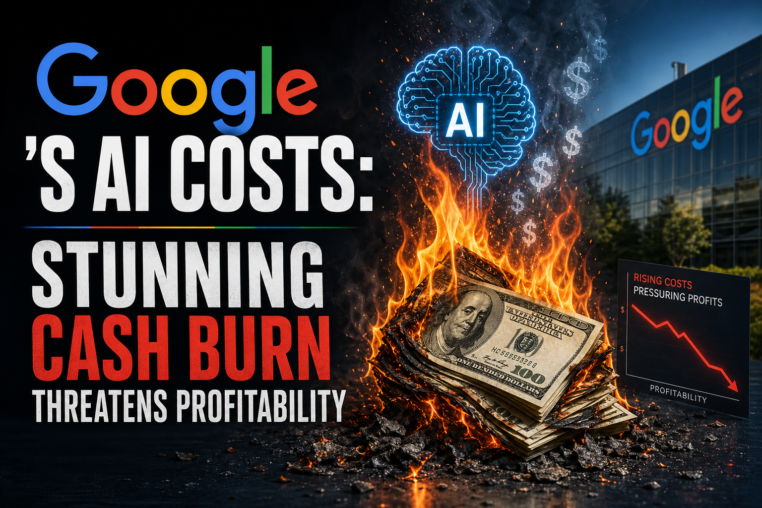
 Google’s AI costs are reaching staggering levels, with the company’s massive investments in artificial intelligence infrastructure creating a stunning cash burn that threatens long-term profitability. As the tech giant races to dominate the generative AI market, its capital expenditures have skyrocketed, raising serious questions among investors and analysts about when—or if—these expenses will translate into sustainable returns. While Google’s parent company, Alphabet, remains one of the most profitable corporations in the world, the sheer scale of its AI spending is unprecedented, and the financial strain is becoming impossible to ignore.
The primary driver of this cash burn is the construction and operation of vast data centers required to train and run advanced AI models. These facilities consume enormous amounts of energy and require specialized hardware, such as graphics processing units (GPUs) from Nvidia. Google has been spending tens of billions of dollars annually on these capital projects, with projections suggesting that figure could climb even higher. In its most recent quarterly earnings report, Alphabet revealed that capital expenditures had surged by over 50% year-over-year, largely due to AI investments. This aggressive spending has outpaced revenue growth from AI products, creating a widening gap that alarms shareholders.
The Scale of Google’s AI Investments
To understand the threat to profitability, one must grasp the sheer magnitude of Google’s AI costs. The company is not just building data centers; it is also investing heavily in research and development, acquiring AI startups, and integrating AI features across its entire product suite—from search and cloud services to YouTube and Google Workspace. Each of these initiatives requires substantial financial outlay. For instance, training a single large language model can cost millions of dollars in compute time alone. Google’s Gemini model, its flagship AI offering, is among the most expensive to develop and maintain.
Moreover, the operational costs of running AI services are significant. Every time a user interacts with Google’s AI-powered search or chatbot, it incurs a cost that is many times higher than a traditional search query. While Google has been able to offset some of these expenses through efficiencies and scale, the volume of AI interactions is growing exponentially. This dynamic creates a vicious cycle: more usage drives higher costs, which in turn pressures margins.
How Google’s AI Costs Impact Profitability
The financial impact is already visible in Alphabet’s income statements. While the company still reports robust profits, its operating margin has shown signs of compression. In recent quarters, the margin has dipped as AI-related expenses have risen faster than revenue. Analysts warn that if this trend continues, Google’s AI costs could erode the profitability that has long made it a favorite among investors. The company’s cloud division, which is a key battleground for AI, has also struggled to achieve consistent profitability despite rapid growth.
Another concern is the opportunity cost. The billions of dollars poured into AI could have been used for stock buybacks, dividends, or other investments that directly benefit shareholders. Instead, they are being spent on a technology whose revenue potential remains uncertain. While Google has launched several AI products, such as Gemini Advanced and AI-powered advertising tools, it is still unclear whether these will generate enough incremental revenue to justify the massive upfront investment. Competitors like Microsoft and Amazon are also spending heavily, but Google’s reliance on advertising revenue makes it particularly vulnerable to any downturn.
The Path Forward: Balancing Innovation and Financial Discipline
Despite the alarming cash burn, Google is unlikely to slow its AI spending anytime soon. The company views AI as a existential technology that will define the next era of computing. Falling behind rivals like OpenAI or Microsoft could be far more damaging to its long-term prospects than short-term financial pain. However, Google must find a way to balance innovation with financial discipline. This could involve more aggressive monetization of AI features, such as charging for premium AI services or integrating AI more deeply into its advertising ecosystem.
Cost-cutting measures are also on the table. Google has already implemented layoffs and reduced spending in other areas to free up capital for AI. The company is also working on developing its own custom AI chips, known as Tensor Processing Units (TPUs), to reduce reliance on expensive Nvidia GPUs. These chips could lower the cost of training and running AI models over time. Additionally, Google is exploring more efficient AI architectures that require less computational power, which could help contain expenses.
Investor Sentiment and Market Reactions
Investor sentiment regarding Google’s AI costs is mixed. Some see the spending as a necessary investment in future growth, drawing parallels to the company’s early investments in cloud computing and mobile advertising, which eventually paid off handsomely. Others are more skeptical, pointing to the lack of clear returns and the risk of a bubble in AI spending. The stock price has been volatile, reacting to each earnings report and any news about AI competition.
Ultimately, Google’s AI costs represent a high-stakes gamble. The company is betting that its massive cash burn will eventually lead to a dominant position in the AI market, generating new revenue streams that far exceed the initial investment. If successful, Google could emerge stronger than ever. If not, the stunning cash burn could become a cautionary tale about the perils of unchecked ambition in the tech industry. For now, all eyes are on Google’s next moves as it navigates this costly but crucial transformation.