
 Written by
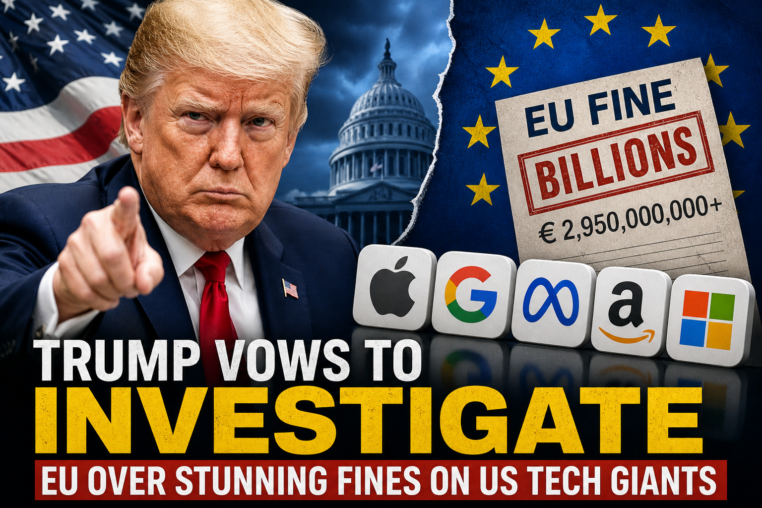
 Trump vows to investigate EU over stunning fines on US tech giants, a move that signals a potential escalation in transatlantic trade tensions. The former president’s announcement comes in response to what he describes as “unfair and aggressive” penalties levied by the European Union against American technology companies. In a statement released from his campaign headquarters, Trump characterized the EU’s regulatory actions as a direct attack on American economic sovereignty, promising to launch a formal investigation if he returns to office. The fines, which have reached billions of dollars in recent years, target industry leaders such as Google, Apple, and Meta, citing violations of antitrust laws and data privacy regulations.
The European Union has long pursued a stringent regulatory framework for digital markets, culminating in landmark legislation like the Digital Markets Act and the General Data Protection Regulation. These laws empower EU regulators to impose substantial fines on companies that abuse market dominance or mishandle user data. For instance, Google alone has faced over €8 billion in penalties since 2017 for practices ranging from illegal advertising agreements to restricting competition in online shopping. Similarly, Apple was hit with a €1.8 billion fine in 2024 for anti-steering provisions in its App Store, while Meta has been penalized for data privacy breaches. Trump’s vow to investigate these fines reflects a broader frustration among American policymakers who view the EU’s approach as protectionist and detrimental to U.S. economic interests.
The former president’s proposed investigation would likely focus on whether the EU’s fines violate international trade agreements or constitute discriminatory practices against American companies. Trump has previously threatened tariffs on European goods in response to digital services taxes, and this new promise suggests a continuation of that aggressive trade posture. His supporters argue that the EU’s regulatory actions undermine American innovation and competitiveness, while critics warn that such an investigation could further strain diplomatic relations and trigger a trade war. The stakes are high, as the transatlantic digital economy is valued at trillions of dollars, and any disruption could have ripple effects across global markets.
The EU’s Regulatory Framework and Its Impact on US Tech Giants
At the heart of the controversy is the European Union’s comprehensive approach to regulating digital markets. The Digital Markets Act, which came into full effect in 2024, designates certain companies as “gatekeepers” and imposes strict obligations to ensure fair competition. These rules prohibit practices like self-preferencing, tying products, and restricting data portability. Violations can result in fines of up to 10% of a company’s global annual revenue, with repeat offenders facing penalties of up to 20%. For US tech giants, these fines represent a significant financial burden and a challenge to their business models. The EU argues that such regulations are necessary to protect consumers and foster competition, but critics in the United States contend that they disproportionately target American firms.
The data privacy landscape further complicates matters. The General Data Protection Regulation, enacted in 2018, imposes strict requirements on how companies collect, store, and process personal data. Non-compliance can lead to fines of up to 4% of global annual revenue. Meta, for example, was fined €1.2 billion in 2023 for transferring user data to the United States without adequate safeguards. These penalties have prompted US lawmakers to call for a more coordinated response, with some advocating for reciprocal regulations or trade sanctions. Trump’s vow to investigate the EU over these fines taps into a growing sentiment that the United States must defend its economic interests more assertively.
Potential Consequences of a US Investigation
If Trump follows through on his promise, the investigation could take several forms. It might involve a review by the Office of the United States Trade Representative, which could recommend retaliatory tariffs or other trade measures. Alternatively, the investigation could lead to diplomatic negotiations aimed at harmonizing regulatory standards between the US and the EU. However, past attempts at such negotiations have yielded limited results, as the two sides hold fundamentally different views on issues like data privacy and antitrust enforcement. A more confrontational approach could escalate tensions, potentially leading to a cycle of retaliatory actions that harm businesses on both sides of the Atlantic.
The timing of Trump’s announcement is also significant, as it comes amid a broader debate over the role of big tech in society. Some US policymakers argue that the EU’s fines are justified and that American regulators should adopt similar measures to curb corporate power. Others, however, see the fines as an overreach that undermines US competitiveness. Trump’s stance aligns with the latter view, positioning him as a defender of American industry against foreign interference. Whether this resonates with voters remains to be seen, but it is clear that the issue of tech regulation will remain a flashpoint in US-EU relations for the foreseeable future.
In conclusion, Trump vows to investigate EU over stunning fines on US tech giants, setting the stage for a potential confrontation that could reshape the global digital economy. The outcome of this promised investigation will depend on political dynamics in both Washington and Brussels, as well as the broader trajectory of transatlantic trade relations. For now, the tech industry watches closely, aware that the decisions made in the coming months could have lasting implications for innovation, competition, and international cooperation.