 Written by
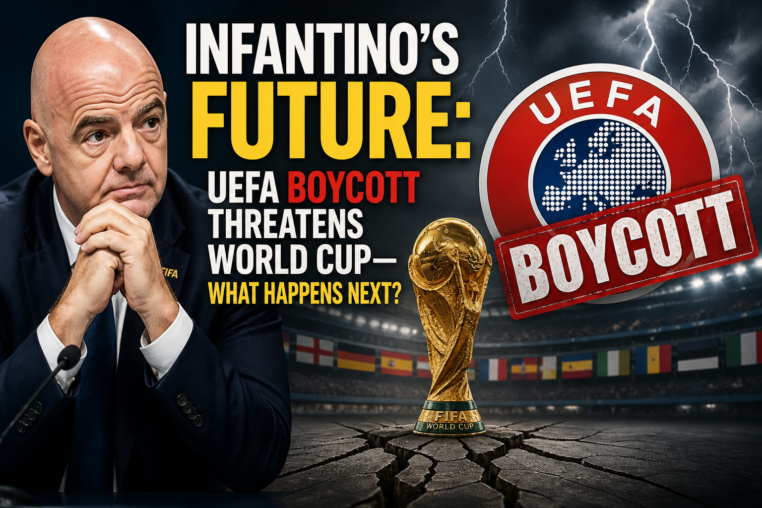
 Infantino’s future now hinges on a geopolitical chess match that could redefine the global game. The stakes are no longer just about trophies or television rights; they are about the very structure of international football. With UEFA’s leadership openly threatening a boycott of the World Cup, the football world is bracing for a seismic shift that could leave FIFA isolated and its flagship tournament in tatters.
The Genesis of the Conflict: Why UEFA Is Pushing Back
To understand the current crisis, we must look at the catalyst. For years, European federations have grumbled about the expanding FIFA calendar. The proposed 64-team World Cup in 2034, coupled with the new 32-team Club World Cup, has stretched player workloads to breaking points. UEFA President Aleksander Čeferin has been vocal, arguing that these expansions are driven by commercial greed rather than sporting merit.
However, the immediate trigger for the boycott threat is more personal. Reports suggest that FIFA’s recent governance reforms have effectively sidelined European influence in favor of Asian and African blocs. When UEFA’s proposals for a streamlined qualification process were dismissed without debate, the relationship fractured. Now, Čeferin has stated that if FIFA proceeds with its current trajectory, European nations will refuse to participate in the 2026 World Cup, a tournament they are expected to dominate.
The Economic Fallout: Can FIFA Survive Without Europe?
The most immediate question regarding Infantino’s future is financial. The World Cup generates over 80% of FIFA’s revenue, and the majority of that comes from European broadcasters and sponsors. If UEFA boycotts, the tournament becomes a hollow shell. Without France, Germany, Spain, and England, the global audience collapses, and sponsors like Coca-Cola and Adidas would likely trigger exit clauses.
FIFA’s reserve funds, estimated at nearly $4 billion, might cushion the blow for a cycle, but the long-term damage would be catastrophic. A World Cup without European teams would be viewed as a minor trophy, akin to a regional championship. This economic reality is why many insiders believe the boycott threat is a high-stakes bluff. Yet, if UEFA calls FIFA’s bluff, Infantino’s future as a financial steward becomes untenable.
The Legal and Political Labyrinth
Beyond the money, there is the legal quagmire. UEFA’s threat to boycott is not merely a political statement; it involves complex statutes regarding player release. Under FIFA regulations, clubs are obligated to release players for international duty. However, if UEFA instructs its member associations to refuse participation, this regulation becomes unenforceable.
Furthermore, the Court of Arbitration for Sport (CAS) could become involved. UEFA might argue that FIFA’s expansion plans violate the principle of fair competition and player welfare. Conversely, FIFA could counter-sue for breach of contract, claiming that UEFA is bound by its membership obligations. This legal battle could drag on for years, leaving the 2026 tournament in a state of suspended animation.
The Power Play: Infantino’s Counter-Moves
Infantino’s future depends on his ability to outmaneuver UEFA. He has already begun courting alternative markets. The recent deals with Saudi Arabia and China are designed to create a new financial ecosystem that does not rely on European money. By shifting the commercial center of gravity to the Middle East and Asia, Infantino hopes to render the UEFA boycott toothless.
However, this strategy has a fatal flaw: the quality of play. Even with massive investment, the national teams of Asia and Africa cannot yet match the tactical sophistication of Europe. A World Cup featuring Brazil, Argentina, and a few European B-teams would lack the competitive edge that makes the tournament magical. Fans would notice, and ratings would plummet.
What Happens Next: Three Possible Scenarios
As we look toward the horizon, three distinct paths emerge for Infantino’s future.
Scenario One: The Compromise
The most likely outcome is a last-minute compromise. FIFA might reduce the proposed 64-team format to 48, or offer UEFA greater governance concessions. This would allow both parties to save face. Infantino would claim victory for expanding the game, while UEFA could claim it protected player welfare. This scenario preserves the status quo but leaves underlying tensions unresolved.
Scenario Two: The Split
A more radical outcome would be a formal split, with UEFA creating its own rival tournament. This would effectively end the World Cup as we know it. While this seems extreme, the precedent exists in the breakaway European Super League, which was only halted by fan protests. If UEFA believes FIFA is irredeemable, a parallel “European Nations Championship” could become the new gold standard.
Scenario Three: The Fall
The darkest timeline involves Infantino’s ouster. If UEFA follows through on the boycott and the tournament flops, FIFA’s congress could vote him out. His allies in the Asian and African confederations might stand by him, but the financial collapse would force a vote of no confidence. In this scenario, Infantino’s future ends in disgrace, and FIFA would need a decade to rebuild trust.
The Bottom Line for Fans
For the average supporter, this political turmoil is frustrating. We want to watch football, not governance battles. Yet, the outcome of this crisis will dictate the sport’s structure for the next generation. If the boycott happens, the 2026 World Cup could be a diminished spectacle. If it is resolved, we may see a bloated, commercialized tournament that prioritizes quantity over quality.
Infantino’s future is not just about one man’s career; it is about the soul of the game. The next few months will reveal whether football remains a global unifier or fractures into regional fiefdoms. For now, all we can do is watch, wait, and hope that the beautiful game survives its own administrators.