 Written by
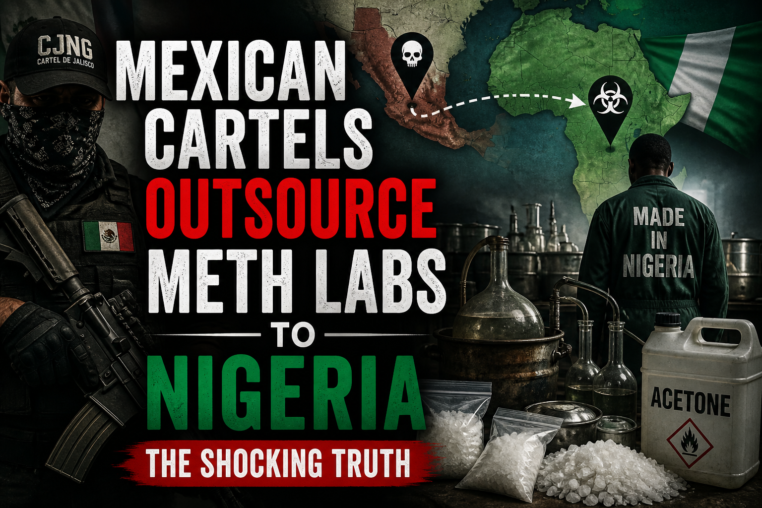
 Mexican cartels outsource meth labs to Nigeria, and this shift represents one of the most significant and unsettling developments in the global drug trade in recent years. For decades, the production of methamphetamine was largely considered a North American problem, with superlabs operating primarily in Mexico and, to a lesser extent, the United States. However, a combination of aggressive law enforcement crackdowns, precursor chemical regulations, and the ever-present pursuit of higher profit margins has forced these criminal organizations to rethink their logistics. The result is a new, dangerous frontier in West Africa, where Nigerian criminal networks have become the unlikely manufacturing partners for some of the world’s most powerful drug syndicates.
This is not merely a story about drugs; it is a story about globalization, corruption, and the adaptive nature of organized crime. The partnership between Mexican cartels and Nigerian gangs is a marriage of convenience that leverages the strengths of both regions. The cartels possess the chemical knowledge, the established distribution networks in the United States and Europe, and the immense capital required to scale production. Nigeria, on the other hand, offers a volatile mix of factors that make it an ideal production hub: a massive, youthful population facing high unemployment, a notoriously corrupt and under-resourced law enforcement sector, and a geographic location that provides access to both European and Asian markets.
The Logistics of the Outsourcing Shift
The primary driver behind this outsourcing is the tightening of precursor chemical controls. Methamphetamine production requires chemicals like pseudoephedrine and ephedrine, which are heavily monitored in North America. To circumvent these restrictions, cartels have historically relied on the “P2P” (phenyl-2-propanone) method, which uses different, less-regulated chemicals. However, even these are now subject to scrutiny. In Nigeria, however, the importation and diversion of these industrial chemicals are significantly easier. Ports like Lagos and Port Harcourt are notorious for porous security, allowing massive shipments of precursor chemicals to arrive under the guise of legitimate industrial use, often with the complicity of customs officials who are either bribed or simply overwhelmed by the volume of cargo.
Furthermore, the operational costs in Nigeria are a fraction of what they are in Mexico. Labor is cheaper, and the cost of real estate for clandestine labs—often located in remote areas of the Niger Delta or in the outskirts of major cities—is minimal. This allows the cartels to operate with a lower overhead, increasing their profit margins substantially. The cartels do not need to send their own people to run these labs; instead, they send “cooks” or chemists to train local Nigerian operatives. Once the local crews are proficient, the Mexican operatives leave, reducing the risk of their own arrest and deportation.
The Role of Nigerian Criminal Networks
The Nigerian partners in this scheme are not random street gangs. They are sophisticated, transnational criminal organizations with established smuggling routes that have been used for decades for heroin and cocaine trafficking. These groups have long-standing connections in Europe, particularly in the UK, Italy, and Spain, which serve as primary distribution hubs for the finished methamphetamine. By partnering with the Mexican cartels, the Nigerians gain access to the cartels’ superior quality “crystal” meth recipe, which is currently dominating the global market. This is a significant upgrade from the low-quality meth that was previously produced in West Africa using over-the-counter cold medicines.
This collaboration has created a “glocal” drug trade—local production with global reach. The meth produced in Nigeria is not just for the local West African market; it is specifically manufactured for export. The product is often shipped via maritime containers hidden among legitimate goods like textiles or agricultural products, heading directly to European ports. This bypasses the traditional land route through the US-Mexico border, which is currently heavily fortified. It is a strategic pivot that allows the cartels to maintain their market share in Europe without risking their supply lines in the Americas.
The Shocking Truth: The “Superlab” Presence
Intelligence reports and law enforcement seizures have confirmed the existence of “superlabs” in Nigeria that are capable of producing hundreds of kilograms of methamphetamine in a single production cycle. These are not makeshift kitchen operations; they are industrial facilities equipped with glass reactors, industrial dryers, and the necessary ventilation systems to handle toxic fumes. The discovery of these labs has shocked international observers because it indicates a level of industrial sophistication that was previously thought to be exclusive to Mexico or Southeast Asia.
The environmental and social impact of these labs is devastating. The production process generates massive amounts of toxic waste, which is often dumped into local waterways or open pits, poisoning the soil and water supplies of nearby communities. Additionally, the influx of cash into local economies has fueled corruption and violence. Rival gangs fight for control of the production sites, and the availability of cheap, high-purity meth has led to a spike in local addiction rates, a problem that Nigeria was ill-prepared to handle.
The Response and the Future of the Trade
The Nigerian government, with assistance from the DEA and the UN Office on Drugs and Crime, has begun to crack down on these operations. Several high-profile lab busts have occurred in recent years, leading to the arrest of both Nigerian chemists and Mexican liaisons. However, the cartels are resilient. They are already adapting by moving operations to other West African nations with weaker enforcement, such as Ghana and Benin, or by breaking up the production into smaller, mobile “kitchen” labs that are harder to detect.
The outsourcing of meth production to Nigeria is a stark reminder that the war on drugs is a constantly shifting battlefield. As long as there is demand in the West and instability in the developing world, criminal networks will find a way to connect the two. The shocking truth is that the Mexican cartels have effectively globalized their business model, turning Nigeria into a manufacturing hub that poses a direct threat to global public health and security. This is not a problem that Nigeria can solve alone; it requires a coordinated, international effort to address the root causes of corruption, poverty, and the insatiable demand for narcotics. Until then, the labs will continue to operate, hidden in the shadows of the Niger Delta, feeding a global addiction.