
 Written by
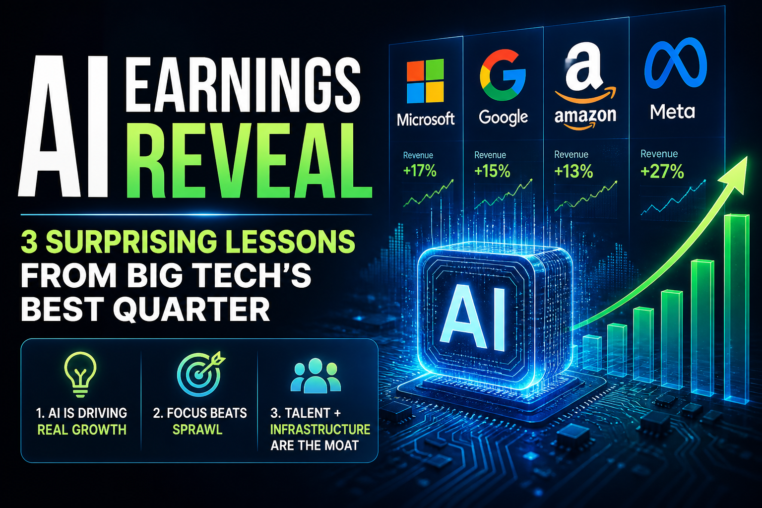
 AI earnings have become the most closely watched financial metric in the market, and the latest reporting season from Big Tech delivered what many analysts are calling the sector’s best quarter in years. But beneath the record-breaking revenue figures and soaring profit margins, the numbers tell a more nuanced story. While the headline results were undeniably impressive, the underlying data reveals three surprising lessons that challenge conventional wisdom about artificial intelligence, capital spending, and the future of the tech industry. These insights are not just relevant for investors; they offer a critical roadmap for businesses and developers navigating the AI landscape.
Lesson One: The “Efficiency Dividend” is Outpacing Pure Revenue Growth
The first surprise from the earnings calls was the shift in focus from top-line growth to operational efficiency. For the past two years, the narrative has been dominated by a land-grab mentality—companies spending billions on GPUs and data centers to win the AI race. However, this quarter, the biggest winners were not necessarily the companies that spent the most, but those that demonstrated a clear path to profitability with their existing AI infrastructure.
Specifically, hyperscalers reported that their AI services are now contributing significantly to operating income, not just revenue. This is a crucial distinction. In previous quarters, executives touted “AI-driven revenue” as a nebulous concept. Now, they are breaking down exactly how inference costs have dropped and how model optimization has improved margins. The lesson here is that the market is rewarding capital discipline. Companies that are using techniques like model distillation and quantization to deliver AI features at a fraction of the previous cost are seeing their stock prices surge. The era of “spend at all costs” is over; the era of “spend smart” has begun. This efficiency dividend is proving to be a more reliable driver of shareholder value than raw revenue expansion, signaling that the industry is maturing from a startup phase into a scalable utility phase.
Lesson Two: Enterprise Adoption is Driven by Workflow Integration, Not Standalone Chatbots
The second surprising lesson revolves around where the money is actually being made. While consumer-facing AI assistants have captured the public imagination, the earnings data reveals that the real financial engine is enterprise workflow integration. Big Tech executives reported that the most significant growth is coming from AI embedded directly into existing productivity suites, cloud databases, and cybersecurity protocols—not from standalone generative AI products.
This is a paradigm shift. Early predictions suggested that users would flock to separate AI apps for writing, coding, or image generation. Instead, the data shows that businesses are paying premium prices for AI that lives inside the tools they already use. For example, revenue from AI-powered code completion tools and automated customer service integrations has skyrocketed, far exceeding the revenue from consumer chatbot subscriptions. The lesson for the broader market is that the “killer app” for AI is not a new interface; it is the invisible augmentation of existing workflows. Companies that have successfully woven AI into their legacy software are seeing lower churn rates and higher average revenue per user, proving that stickiness is more valuable than novelty.
Lesson Three: The Supply Chain is the New Competitive Moat
Finally, the most counter-intuitive lesson from this earnings season is the re-evaluation of the hardware supply chain. For years, the assumption was that software would capture all the value in the AI boom, with hardware relegated to commodity status. The latest earnings reveal that this is categorically false. Big Tech companies that have secured custom silicon (like TPUs and custom ARM-based CPUs) or have direct equity stakes in memory and power supply manufacturers are reporting significantly higher gross margins than those reliant on third-party vendors.
The surprise here is the extent to which power and memory constraints are limiting growth. Executives openly discussed that their biggest bottleneck is not model architecture, but the physical availability of high-bandwidth memory and electrical grid capacity. Consequently, the companies that are vertically integrating—investing in their own chip design teams and signing long-term power purchase agreements—are pulling ahead. This suggests that the future of AI leadership lies in controlling the physical infrastructure as much as the algorithms. The market is beginning to value these companies not just as software firms, but as industrial conglomerates with a technological edge, fundamentally changing how we assess their valuation multiples.
What This Means for the Road Ahead
Looking past the headline numbers, these three lessons paint a picture of an industry that is consolidating and becoming more pragmatic. The “best quarter ever” was not defined by reckless expansion, but by strategic refinement. The winners are those who have figured out how to do more with less, integrate deeply into enterprise systems, and secure their supply chains against geopolitical and physical disruptions.
For investors, this means looking beyond simple revenue growth and paying attention to operating leverage and infrastructure ownership. For business leaders, it means that the most successful AI strategies are those that solve specific, existing problems rather than chasing speculative use cases. The AI earnings season has proven that the technology has moved past the hype cycle and into a phase of rigorous economic validation. The companies that adapt to these three lessons—efficiency, integration, and supply chain control—will not only survive the next downturn but will define the next decade of computing.