 Written by
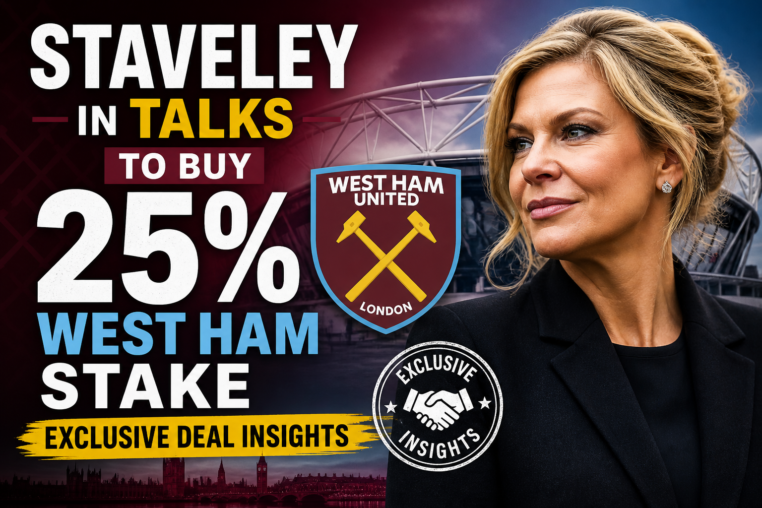
 Amanda Staveley in talks to buy 25% West Ham stake, a move that could reshape the financial landscape of the East London club. The news, which emerged exclusively from sources close to the negotiations, signals a potential end to the tenure of the current ownership group led by David Sullivan and the late David Gold’s family. For a club that has long operated with a reputation for frugality in the transfer market, the prospect of a cash-rich, globally connected investor is sending ripples of cautious optimism through the London Stadium faithful.
The proposed deal, which values the club at a figure believed to be in excess of £500 million, is not a full takeover. Instead, Staveley’s vehicle is looking to acquire a significant minority stake of 25 percent. This structure is critical to understanding the immediate implications. It suggests that the current majority shareholders are not looking to walk away entirely but are willing to dilute their holdings to bring in fresh capital and expertise. For Staveley, known for her role in brokering the Saudi Arabian Public Investment Fund’s (PIF) acquisition of Newcastle United, this represents a calculated entry point into the London market without the astronomical price tag of a full purchase.
The Strategic Rationale Behind the 25 Percent Acquisition
Why would Staveley, a woman accustomed to high-stakes, full-scale takeovers, settle for a quarter of the club? The answer lies in the specific economics of West Ham. The club’s valuation has skyrocketed in recent years, driven by consistent top-half Premier League finishes and the commercial potential of playing in a 62,500-seater stadium. A full takeover would likely cost upwards of £700 million, a sum that even the wealthiest backers approach with caution given the Financial Fair Play (FFP) and Profit and Sustainability Rules (PSR) constraints.
By purchasing 25 percent, Staveley gains a seat at the table and a significant voice in strategic decisions without inheriting the full risk profile. This is a classic private equity approach: acquire a meaningful minority position, influence operational efficiency, and benefit from capital appreciation. For West Ham, the immediate benefit is liquidity. The injection of funds is earmarked not for the owners’ pockets but for the playing squad and infrastructure, specifically the long-mooted expansion of the London Stadium’s capacity and a significant upgrade to the club’s scouting network.
What This Means for the Transfer War Chest
The most immediate impact of the Amanda Staveley in talks to buy 25% West Ham stake news is the potential shift in transfer policy. Historically, West Ham have been seen as “sellers” in the market, often cashing in on star players like Declan Rice to fund multiple squad additions. The new investment could change that dynamic. With Staveley’s financial muscle and her network of intermediaries, the club could pivot to a “buy low, sell high” model that retains its best assets while acquiring high-potential players from South America and Europe.
Crucially, the 25 percent stake is unlikely to trigger a massive spending spree in the January window. PSR rules limit losses to £105 million over a three-year period. However, the new capital provides headroom. It allows the club to service higher wage bills and amortize transfer fees over longer contracts, a tactic employed by Chelsea and Arsenal. This means West Ham could finally compete for the tier of player currently just out of reach—those valued between £40 million and £60 million—without having to sell first.
The Staveley Factor: More Than Just Money
It would be reductive to view this deal purely through a financial lens. Staveley brings a level of sporting ambition and diplomatic acumen that has been lacking. Her tenure at Newcastle was marked by a willingness to listen to the manager and a focus on long-term structural growth rather than short-term fixes. For current manager Julen Lopetegui, or any future incumbent, this is a welcome change.
The negotiation is not without its complexities. The current ownership group has a history of infighting and public disagreements, which has often destabilized the club. Staveley will need to navigate these egos carefully. The deal is structured to give her operational control over football matters—specifically the hiring and firing of the sporting director and the head coach—while the current owners retain control over commercial and stadium operations. This division of power is a delicate balancing act. If she can execute it successfully, she replicates the “Newcastle model” where the football side operates independently of the balance sheet.
Potential Hurdles and the Road Ahead
Despite the optimism, the deal is not yet done. The Premier League’s Owners’ and Directors’ Test remains a significant hurdle. While Staveley passed this test during the Newcastle takeover, the source of her funding for this specific venture is under scrutiny. Reports suggest she is leveraging a consortium of US-based investors, which could complicate the “fit and proper” assessment. Furthermore, there is the question of the London Stadium lease. The club’s agreement with E20, the stadium’s owners, contains clauses regarding ownership changes, and any new investor must be approved by the LLDC (London Legacy Development Corporation).
If the deal completes, it signals a new era. The immediate future is likely to see a restructuring of the football operations department, with a new director of football expected to be appointed within weeks of the ink drying. For the fans, the hope is that this 25 percent stake is the first step toward a more ambitious, less risk-averse club. While it is not the full takeover many dreamed of, it is a decisive break from the penny-pinching past. The coming weeks will be crucial as due diligence concludes, but for the first time in years, the trajectory at the London Stadium points firmly upward.