
 Written by
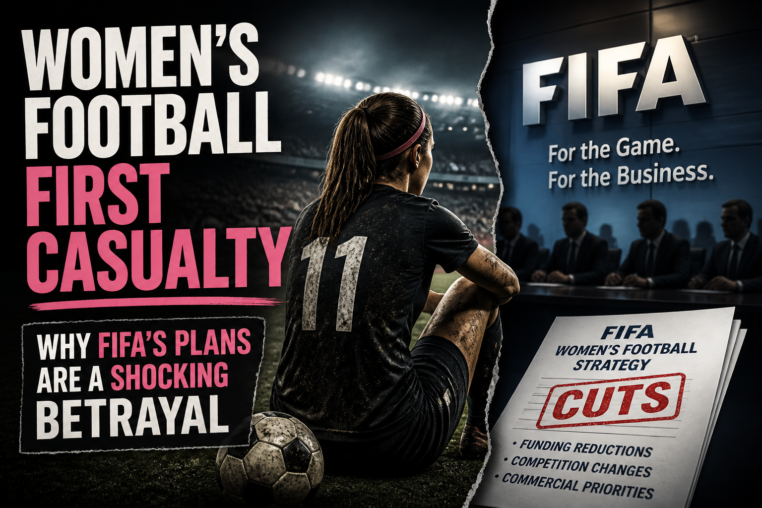
 Women’s football is facing its first major existential crisis of the modern era, and the threat is not coming from a rival league, a funding shortfall, or a global pandemic. The danger is coming from the very institution tasked with protecting the game: FIFA. The governing body’s recent proposals, which prioritize a congested calendar and commercial expansion over player welfare, are not just a logistical misstep; they are a shocking betrayal of the sport’s most valuable asset—its athletes.
For a decade, the narrative surrounding the women’s game has been one of unbridled ascension. Record-breaking attendances at the 2023 World Cup, sold-out stadiums for domestic derbies, and lucrative broadcast deals have signaled a new dawn. However, this growth has been built on a fragile foundation. The professionalization of the sport has outpaced the infrastructure designed to support it, leading to a grueling schedule that pushes players to their physical and mental limits. Now, FIFA’s plan to introduce a new 32-team Club World Cup and expand the Women’s World Cup to 48 teams threatens to shatter that foundation completely.
The Crushing Weight of the Calendar: Why FIFA’s Plans Are a Shocking Betrayal
The core issue is the sheer volume of matches. Top-tier players are already competing in domestic leagues, domestic cups, continental championships, and international friendlies. The addition of a biennial Club World Cup, set to debut in 2026, does not simply add a few games to the calendar; it eliminates the off-season entirely. We are looking at a scenario where elite female footballers, who often earn a fraction of their male counterparts, are expected to play over 70 matches a year, traversing continents for commercial exhibitions while their bodies break down.
This is not hyperbole; it is arithmetic. The human body requires recovery time, particularly for female athletes who face distinct physiological stressors related to the menstrual cycle, bone density, and ACL injury susceptibility. Research has consistently shown that female footballers are up to six times more likely to suffer from anterior cruciate ligament injuries than male players. Cramming more high-intensity fixtures into an already bloated schedule is a direct and reckless disregard for this medical evidence. By prioritizing a tournament that serves primarily as a cash cow for broadcasters and sponsors, FIFA is effectively gambling with the careers of the very players who have made the sport’s growth possible.
Player Welfare vs. Commercial Greed: The Unfair Trade-Off
The argument from FIFA’s leadership is that these expanded tournaments will “grow the game” and provide more opportunities for nations to compete on the global stage. On the surface, this sounds inclusive. However, the reality is that the expansion dilutes the quality of the competition and exacerbates the gap between the haves and the have-nots. While a 48-team World Cup might allow a debutant nation to experience the tournament, it also forces the established powers—and their star players—to play an additional round of knockout matches against overmatched opponents. The result is a series of lopsided scorelines that bore casual fans and a schedule that physically destroys the players who actually matter to the product.
Furthermore, the financial distribution remains deeply inequitable. While FIFA generates record revenues from the women’s game, the prize money and club compensation packages offered to female players remain a fraction of what is available to men. The players are being asked to sacrifice their bodies for a tournament that does not adequately compensate them for the increased risk. This is not growth; it is exploitation. The players are not stakeholders in this plan; they are pawns in a geopolitical and commercial chess game.
The Players Have Had Enough
The silence of the players is over. We have seen the rise of collective action, with national teams like the USWNT, Spain, and Nigeria fighting for better conditions, equal pay, and basic respect. The current generation of athletes is educated, vocal, and unwilling to accept the status quo. They understand that the “shocking betrayal” is not just about the number of games, but about the lack of consultation. FIFA has reportedly made these decisions without meaningful input from the players’ unions (FIFPRO) or the players themselves. This top-down approach is a relic of a bygone era, and it is destined to fail.
If FIFA proceeds with these plans without a radical overhaul of the calendar—including mandatory rest periods, a hard cap on minutes played, and a revenue-sharing model that actually benefits the athletes—they will face a backlash unlike anything the sport has seen. We are already seeing the early warning signs: players reporting burnout, high-profile retirements at the peak of their careers, and a growing sentiment that the professional game is becoming unsustainable.
A Call for a Sustainable Future
The solution is not to cancel the tournaments, but to redesign the ecosystem. The women’s game needs a dedicated international match calendar that runs on a four-year cycle, allowing for a proper pre-season and a genuine off-season. It requires a commitment to travel standards that prioritize rest and recovery over marketing opportunities. Most importantly, it requires FIFA to treat the players as partners, not as inventory.
The growth of women’s football is a beautiful thing, but it is fragile. If FIFA continues down this path, they will not only betray the players who have built this momentum; they will kill the golden goose. The first casualty of this reckless ambition will not be a team or a league—it will be the health and careers of the women who play the game. The time for FIFA to listen is now, before the damage becomes irreversible. The world is watching, and the players are ready to fight for their future.