 Written by
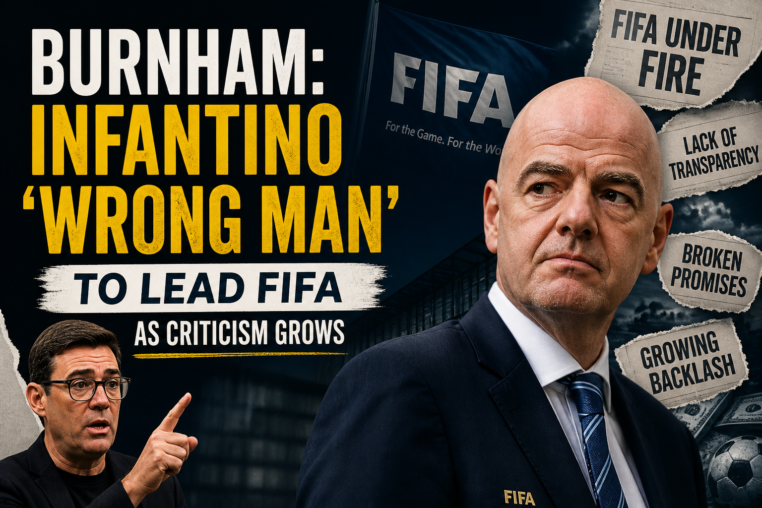
 Gianni Infantino has become the “wrong man” to lead FIFA, according to former English Football Association chairman Greg Dyke, who has launched a blistering attack on the current FIFA president. Infantino’s leadership has been under intense scrutiny for years, but the criticism has reached a fever pitch following a series of controversial decisions, opaque financial dealings, and a perceived authoritarian grip on the sport’s global governing body. Dyke, who has never shied away from speaking his mind, argues that the Swiss-Italian administrator has fundamentally misunderstood the role of the presidency, prioritizing personal ambition and commercial gain over the integrity and development of football worldwide.
The latest wave of condemnation centers on FIFA’s handling of the expanded 2026 World Cup, which will see 48 teams compete across the United States, Canada, and Mexico. While the expansion was initially sold as a way to grow the game in developing nations, critics argue that the increased revenue from a longer tournament has come at the cost of player welfare. The congested international calendar, coupled with the introduction of a new 32-team Club World Cup, has stretched elite athletes to their physical limits. Dyke’s assertion that Infantino is the “wrong man” stems from this disconnect between the president’s grandiose growth strategies and the practical realities facing players, domestic leagues, and national associations.
The Erosion of Trust in FIFA’s Leadership
Dyke’s criticism is not an isolated outburst; it reflects a growing consensus among former administrators and football executives that FIFA has regressed into a culture of secrecy and self-congratulation. Under Infantino’s stewardship, the organization has moved its headquarters to a state-of-the-art building in Zurich, increased its cash reserves to record levels, and secured broadcasting deals worth billions. However, this financial prosperity has come at a significant reputational cost. Questions remain over the bidding process for the 2034 World Cup, which was effectively awarded to Saudi Arabia without a formal competitive vote, raising eyebrows about the transparency of the decision-making process.
Furthermore, Infantino’s public persona has often been described as combative and dismissive of legitimate concerns. His tendency to blame European critics for “hypocrisy” regarding human rights issues in host nations has alienated key stakeholders. When Dyke says Infantino is the “wrong man,” he is pointing to this inability to unite the global football community. A leader of FIFA, Dyke argues, should be a diplomat and a guardian of the sport’s values, not a polarizing figure who views dissent as a personal attack. The erosion of trust is palpable; national federations feel pressured to align with the president’s agenda for fear of losing access to FIFA’s lucrative development funding.
The Commercialization vs. Tradition Debate
A central pillar of the argument that Infantino is the “wrong man” lies in his aggressive commercialization of the sport. While previous presidents like João Havelange and Sepp Blatter were certainly not saints, they understood the delicate balance between business and tradition. Infantino, however, appears to view football primarily as a product to be monetized. The proposal for a biennial World Cup, which was floated and then shelved due to massive opposition from UEFA and CONMEBOL, is a prime example. The plan was widely seen as a cash grab that would dilute the prestige of the tournament and add further strain to the calendar.
Dyke’s critique highlights a specific fear: that the soul of the game is being sold for short-term profit. The partnership with Saudi Arabia’s sovereign wealth fund, the sponsorship deals with betting companies, and the relentless push for more matches all point to a leadership that values the balance sheet over the grassroots experience. For many, the “wrong man” narrative is about the loss of football’s identity. The sport is no longer just a game; under Infantino, it has become a geopolitical tool and a corporate behemoth, leaving traditional fans feeling alienated and powerless.
A Question of Governance and Accountability
Ultimately, the growing criticism of Infantino boils down to governance. The FIFA Council, which is supposed to oversee the president, has been accused of being a rubber-stamp body, reluctant to challenge his authority. Dyke’s intervention serves as a reminder that the structures designed to hold the leadership accountable are failing. When the president can unilaterally change the rules regarding eligibility, as seen with the rushed approval of the Club World Cup, it demonstrates a concentration of power that is unhealthy for any democratic institution.
The argument that Infantino is the “wrong man” is not merely a personal attack; it is a systemic critique. It suggests that the current leadership model is fundamentally flawed, allowing one individual to wield disproportionate influence over the world’s most popular sport. As the 2026 World Cup approaches, the pressure on Infantino will only intensify. Whether he can weather the storm remains to be seen, but the voices of dissent, led by figures like Greg Dyke, are becoming harder to ignore. The football world is watching, and many believe that a change at the top is not just desirable, but essential for the long-term health of the game.