 Written by
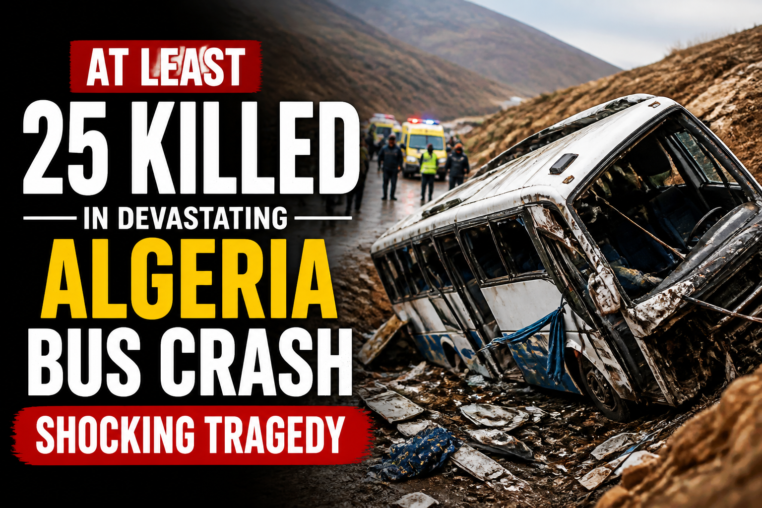
 At least 25 people have been killed in a devastating bus crash in southern Algeria, marking one of the deadliest road accidents the country has witnessed in recent years. The tragedy occurred on Wednesday morning on a desert highway near the town of Tamanrasset, a remote region deep in the Sahara. According to initial reports from Algeria’s civil protection agency, the passenger bus collided head-on with a heavy goods vehicle before bursting into flames, leaving a scene of utter devastation that first responders described as “apocalyptic.” The death toll is expected to rise as rescue teams continue to sift through the charred wreckage, with more than a dozen additional passengers reported injured, several of them in critical condition.
The Fatal Collision and Immediate Aftermath
The accident took place on National Road 1, a major artery that connects the northern coastal cities to the deep south. Eyewitnesses reported that the bus, which was traveling overnight from the capital, Algiers, to Tamanrasset, was attempting to overtake a slower truck when it collided with an oncoming fuel tanker. The impact was so violent that the bus was ripped apart, and the subsequent fire consumed the vehicle within minutes. Local authorities have confirmed that the bus was carrying approximately 45 passengers, many of whom were workers returning to their families for the weekend.
Emergency services arrived at the scene within 30 minutes, but the intensity of the blaze hampered their efforts. “We could hear screams, but we couldn’t get close due to the heat,” one rescue worker told local media. Helicopters were dispatched from the Tamanrasset military base to airlift the most severely injured victims to the regional hospital. By midday, the civil protection agency had cordoned off the area, and heavy machinery was brought in to separate the twisted metal and recover the remains of the victims. The identification process is expected to be slow, as many of the bodies were burned beyond recognition, requiring DNA testing.
Investigating the Root Causes of the Disaster
As the nation mourns, investigators have launched a full inquiry into the crash. Preliminary findings suggest that a combination of driver fatigue and excessive speed are the primary suspected causes. The stretch of road where the accident occurred is notoriously dangerous, with long, monotonous straightaways that lull drivers into a false sense of security. However, the investigation will also focus on the condition of the vehicles involved. The bus, reportedly a 20-year-old model, was flagged for mechanical issues during a routine inspection last month, raising questions about the enforcement of safety regulations for long-distance transport.
Furthermore, the crash has reignited a national debate about road safety in Algeria. The country has one of the highest road fatality rates in North Africa, with the World Health Organization estimating that over 4,000 people die on Algerian roads each year. The government has pledged to modernize the national fleet and install speed cameras, but critics argue that enforcement remains lax, particularly in the vast, sparsely populated southern regions where police presence is minimal. This latest tragedy underscores the urgent need for systemic change, not just in vehicle maintenance, but in driver training and rest-stop infrastructure.
A Nation in Mourning and the Human Toll
The human cost of this crash extends far beyond the immediate victims. In the hours following the news, the Algerian presidency declared a three-day period of national mourning. Flags were lowered to half-mast across the country, and President Abdelmadjid Tebboune offered his condolences to the families of the deceased, vowing to hold those responsible accountable. In Tamanrasset, a makeshift morgue was set up at the local hospital, where hundreds of relatives gathered, waiting in agonizing silence for news of their loved ones. The emotional scenes were heart-wrenching, with many collapsing in grief as the names of the deceased were read out over loudspeakers.
The victims were a cross-section of Algerian society: young students heading home for the holidays, migrant workers from Mali and Niger, and elderly citizens traveling to visit family. One survivor, a 34-year-old man who was thrown from the bus through a shattered window, described the chaos in a hospital bed. “It was dark, and then there was a loud bang. The next thing I knew, I was on the sand, watching the bus burn. I could hear people crying for help, but I couldn’t move,” he recounted. His testimony highlights the sheer violence of the impact and the terror experienced by those on board.
The Broader Implications for Regional Travel
This devastating bus crash also highlights the perilous nature of long-distance travel in the Sahara. For many Algerians, buses remain the only affordable mode of transportation across the country’s vast expanse, where distances between cities can exceed 1,000 kilometers. The government has announced that it will immediately review the licenses of all private bus operators and mandate the installation of GPS tracking devices to monitor speed and driver hours. Additionally, there are calls to establish more emergency response stations along National Road 1, which currently has very few medical facilities for hundreds of kilometers.
While the immediate focus remains on supporting the victims’ families and investigating the cause, this tragedy serves as a grim reminder of the fragility of life and the high price of negligence. As the sun sets over the Sahara, the charred remains of the bus serve as a monument to a preventable loss. The nation now looks to its leaders to transform this sorrow into action, ensuring that the 25 lives lost are not just a statistic, but a catalyst for a safer future on Algeria’s roads. The investigation is ongoing, and the full report is expected to be released in the coming weeks.