
 Written by
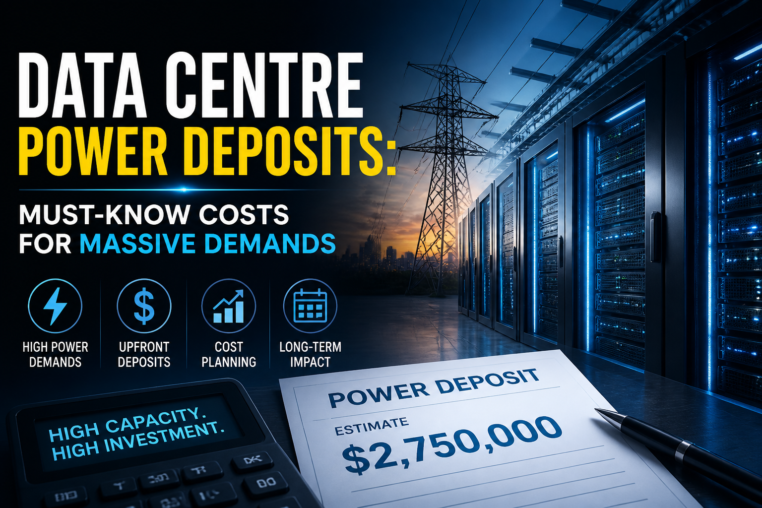
 Data centre power deposits are becoming a critical financial consideration for any organization planning to build or expand a hyperscale facility. As the global demand for cloud computing, artificial intelligence, and high-performance computing skyrockets, the energy requirements of these massive facilities have reached unprecedented levels. Securing enough power from local utilities is no longer a simple matter of flipping a switch; it often involves substantial upfront payments known as power deposits. These deposits are essentially a financial guarantee that a data centre operator will actually consume the reserved capacity, protecting the utility from the risk of building out expensive infrastructure for a project that may not materialize. Understanding these costs is essential for budgeting, project feasibility, and long-term operational planning.
The Rationale Behind Power Deposits
Utilities operate on a model of predictable demand and infrastructure investment. When a data centre requests a connection capable of drawing 50, 100, or even 200 megawatts, the utility must upgrade substations, install new transformers, and run high-voltage transmission lines. These are multi-million dollar projects that cannot be recouped if the data centre pulls out. Therefore, data centre power deposits serve as a risk mitigation tool for the utility. The deposit is often calculated as a percentage of the total infrastructure upgrade costs, or it may be based on a fixed rate per megawatt of reserved capacity. For example, a utility might require a deposit of $500,000 per megawatt, meaning a 100 MW facility would need to put down a staggering $50 million just to secure the power agreement.
How Deposit Amounts Are Calculated
The specific amount of a data centre power deposit is not standardized and varies widely based on several factors. First, the existing grid capacity in the chosen location plays a major role. If a site is in an area with ample spare transmission capacity, the deposit may be lower. Conversely, building in a power-constrained region like Northern Virginia or parts of Europe can trigger massive deposits. Second, the timeline for power delivery matters. Expedited requests often command higher deposits because the utility must fast-track its own construction. Third, the utility’s own cost recovery policies dictate the formula. Some utilities use a “contribution in aid of construction” (CIAC) model, where the deposit is directly tied to the cost of new equipment. Others use a “standby fee” structure that converts the deposit into monthly credits over the life of the contract.
The Impact on Data Centre Project Economics
For developers and operators, these deposits represent a significant capital outlay that must be factored into the project’s internal rate of return (IRR). A data centre power deposit can tie up tens of millions of dollars for months or even years before the facility is operational. This capital is not available for other uses, such as purchasing servers or cooling equipment. Furthermore, if the project is delayed or cancelled, the deposit may be partially or fully forfeited, creating a substantial financial risk. To manage this, many operators negotiate “deposit reduction” clauses, where the deposit is gradually refunded as the facility reaches specific power consumption milestones. For instance, once the data centre draws 50% of its reserved capacity for six consecutive months, the utility might refund 50% of the deposit.
Negotiating and Structuring Power Deposits
Savvy data centre developers do not simply accept the utility’s initial deposit quote. There is room for negotiation, especially for large-scale projects that promise long-term revenue for the utility. One common strategy is to offer a phased power delivery schedule. Instead of requesting 100 MW all at once, the operator might ask for 30 MW initially, with the remaining capacity reserved for future phases. This reduces the immediate deposit requirement and aligns the utility’s investment with actual demand. Another tactic is to provide a letter of credit from a major bank instead of a cash deposit. This frees up cash flow while still providing the utility with a secure guarantee. Additionally, some operators form partnerships with the utility, sharing the cost of new infrastructure in exchange for a lower deposit or a guaranteed rate.
The Role of Renewable Energy and On-Site Generation
The conversation around data centre power deposits is increasingly intertwined with sustainability goals. To reduce their reliance on the grid and lower their deposit amounts, many operators are investing in on-site power generation, such as natural gas turbines, fuel cells, or large-scale battery storage. By demonstrating that they can provide a portion of their own power, they can negotiate a lower reserved capacity from the utility, thereby reducing the deposit. Furthermore, utilities in regions with aggressive renewable portfolio standards may offer incentives or reduced deposits for data centres that commit to purchasing renewable energy credits or building dedicated solar farms. This creates a win-win situation: the operator lowers its upfront costs, and the utility meets its green energy targets.
Case Studies: Real-World Deposit Scenarios
To illustrate the scale of these costs, consider a recent project in Loudoun County, Virginia, a global hub for data centres. A 150 MW facility there faced a utility deposit of approximately $45 million due to the need for new substation infrastructure. The operator successfully negotiated a phased approach, paying only $15 million upfront for the first 50 MW, with the remaining deposit due upon expansion. In another example, a project in Ireland, where grid capacity is extremely tight, required a deposit of over €60 million for a 100 MW facility. The operator mitigated this by securing a long-term power purchase agreement (PPA) with a local wind farm, which allowed the utility to reduce the deposit by 20% because the renewable source helped balance the grid.
Future Trends in Power Deposit Structures
As data centre power demands continue to grow, the financial industry is developing new products to manage these deposits. We are seeing the emergence of “deposit insurance” and “deposit financing” from specialized lenders. These institutions will front the deposit for a fee, allowing the operator to preserve its own capital. Additionally, regulatory changes are on the horizon. Some jurisdictions are considering rules that cap deposits as a percentage of total project cost or mandate faster refund timelines. The trend is moving toward more transparent and flexible deposit structures, but for now, operators must be prepared for this substantial, often underestimated, cost.
Conclusion
Data centre power deposits are a non-negotiable reality in the modern digital infrastructure landscape. They represent a significant financial hurdle that can make or break a project’s viability. By understanding how these deposits are calculated, negotiating effectively, and exploring alternative energy strategies, operators can manage these costs and secure the massive power needed to fuel the world’s data demands. Failing to account for these deposits in the early planning stages can lead to budget overruns, project delays, and missed market opportunities. In an industry where speed and scale are paramount, mastering the art of the power deposit is a competitive advantage.