
 Written by
 Gianni Infantino, the president of FIFA, has never been a figure who shies away from the spotlight. Since taking the helm of world football’s governing body in 2016, he has positioned himself as a relentless promoter of the game, but his tenure has been consistently punctuated by diplomatic firestorms, ethical questions, and a surprising political pivot toward the American right. While his mandate focuses on expanding football’s global footprint, his public persona often reads more like a geopolitical strategist than a sports administrator, leading to a complex legacy defined by growth and grievance.
Infantino’s rise to power was, in itself, a masterclass in political maneuvering. Elected in the wake of the massive corruption scandal that ousted Sepp Blatter, he promised transparency and reform. He inherited a fractured organization and immediately set about repairing its image by expanding the World Cup to 48 teams—a move that delighted smaller nations but infuriated European powerhouses concerned about fixture congestion. This expansion was the first sign of his populist approach to governance: prioritize the global majority, even if it alienates the traditional elite. It was a strategy that worked, securing him re-election in 2019 with a landslide victory, largely on the back of votes from Africa, Asia, and the Americas.
However, the sheen of reform has often been dulled by the controversies that seem to follow him. His handling of human rights concerns surrounding the 2022 Qatar World Cup was widely criticized as dismissive. Rather than engaging with the nuanced criticisms regarding migrant worker conditions, Infantino chose to lecture the European media, accusing them of hypocrisy and racism. In a now-infamous press conference, he framed the criticism as an attack on the “3 million migrant workers” and the “1.5 million Muslims” in Qatar, a rhetorical deflection that many journalists saw as a refusal to accept institutional responsibility. This pattern of defensiveness has become a hallmark of his leadership, where criticism is often met with counter-accusations rather than substantive policy changes.
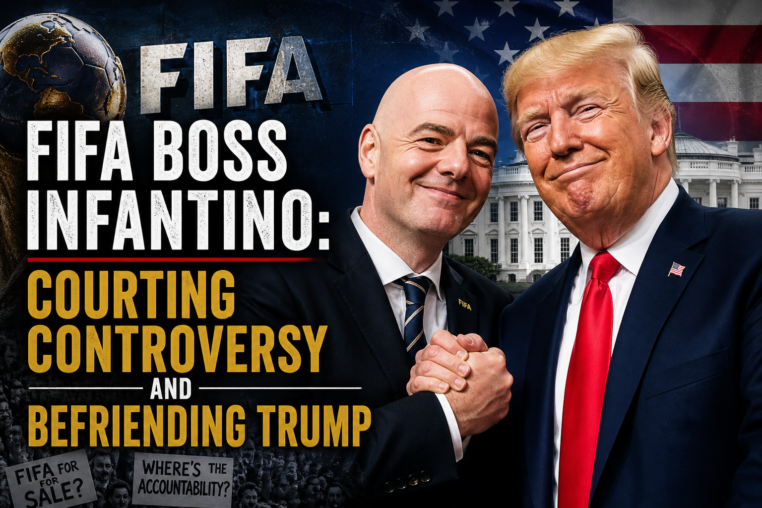
The most striking evolution in Infantino’s tenure, however, is his overt courtship of former President Donald Trump. This relationship has baffled many in the international sports community, given the traditional neutrality expected of FIFA’s president. The alliance became highly visible during the 2026 World Cup hosting cycle, where the joint bid from the United States, Canada, and Mexico was heavily favored. Infantino’s decision to cozy up to Trump—visiting the White House and praising his leadership—was seen by political analysts as a pragmatic move to secure American corporate sponsorship and infrastructure guarantees.
Yet, the friendship goes beyond mere business. Infantino has been photographed at Mar-a-Lago, and the two men have exchanged public compliments that suggest a genuine ideological affinity. Trump has called Infantino a “winner,” while Infantino has praised Trump’s “energy” and “commitment.” For critics, this relationship is deeply problematic. It aligns FIFA with a political figure whose rhetoric on immigration and international cooperation stands in stark contrast to the multicultural, borderless ethos of football. Furthermore, it raises questions about FIFA’s integrity, as the organization seeks to expand its commercial footprint in the lucrative North American market. By aligning so closely with a polarizing political figure, Infantino risks turning FIFA into a partisan player, which is a dangerous position for a body that governs a sport meant to unite people across political divides.
The focus on political alliances has also overshadowed substantive governance issues. Under Infantino, FIFA has accumulated record cash reserves, largely due to aggressive commercialization and the expansion of competitions like the Club World Cup. While financial health is a positive indicator, the distribution of that wealth remains a point of contention. Critics argue that the increased revenue is being used to buy political loyalty among smaller federations, ensuring Infantino’s continued dominance in elections. This cycle of financial dependency and political support creates a system where accountability is scarce, and the president’s power becomes increasingly unassailable.
Moreover, Infantino’s recent proposals regarding the biennial World Cup have sparked a schism within the sport. While UEFA and CONMEBOL (the European and South American confederations) have vehemently opposed the plan, citing player welfare and the dilution of the tournament’s prestige, Infantino has pushed forward, framing the opposition as elitist. He argues that a more frequent World Cup would give more nations the chance to participate in the “greatest show on earth.” While this narrative resonates with developing football nations, it ignores the logistical and physical toll on players, who are already struggling with congested schedules. The debate highlights a fundamental tension in Infantino’s vision: he sees football primarily as a vehicle for global expansion and revenue generation, whereas traditionalists see it as a sacred institution that requires preservation.
In assessing Infantino’s legacy, one must acknowledge his undeniable success in growing the game’s financial and geographic reach. He has brought football to new audiences and secured unprecedented investment. However, his combative style and willingness to embrace controversial political figures have tarnished the moral authority of the organization he leads. The relationship with Trump, in particular, serves as a litmus test for his priorities. Is he courting the American president to secure the best infrastructure for the 2026 World Cup, or is he signaling a broader ideological alignment that could alienate a significant portion of the global fanbase?
As the 2026 World Cup approaches, the world will be watching how this alliance plays out on the international stage. Infantino has proven himself to be a survivor, adept at navigating the murky waters of global sports politics. Yet, by consistently courting controversy and befriending divisive leaders, he has ensured that his tenure will be remembered not just for the football played, but for the political tightrope he walked. Whether this strategy ultimately benefits the beautiful game or undermines its unifying power remains the defining question of his presidency.