
 Written by
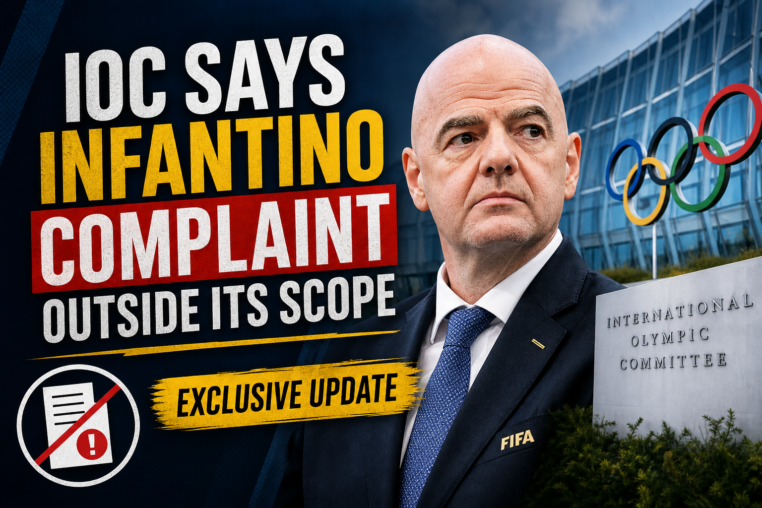
 The International Olympic Committee (IOC) has officially stated that a formal complaint lodged against FIFA President Gianni Infantino falls outside its jurisdictional scope, marking a significant development in the ongoing governance disputes within international football. The decision, confirmed in an exclusive update, clarifies the boundaries between the world’s largest sporting bodies and raises questions about accountability mechanisms in global sports administration.
The complaint in question, which was submitted by an unnamed party, alleged that Infantino had violated certain ethical standards and governance protocols during his tenure at FIFA. However, the IOC’s response was unequivocal: the matter does not pertain to Olympic-related activities or the Olympic Charter, and therefore the committee has no authority to investigate or adjudicate. This ruling effectively closes the door on any potential IOC-led inquiry, leaving the issue to be addressed by FIFA’s own internal bodies or other relevant authorities.
The IOC’s decision is rooted in the strict separation of powers between different international sports federations. While the IOC oversees the Olympic Games and coordinates with various sports governing bodies, its jurisdiction is limited to matters directly impacting the Olympic movement. Infantino’s role as FIFA president, while influential in the broader sports landscape, is not subject to IOC oversight unless the alleged misconduct involves Olympic events or violates the Olympic Charter. This legal and procedural clarity is essential for maintaining the autonomy of each organization, but it also highlights potential gaps in global sports governance.
This development comes at a time when Infantino has been a polarizing figure in football administration. His leadership has been marked by ambitious reforms, including the expansion of the FIFA World Cup and increased financial transparency, but also by controversies surrounding human rights issues in host countries and allegations of undue influence. The complaint, though now outside the IOC’s scope, adds to the scrutiny surrounding his tenure. Critics argue that the lack of a unified oversight body allows powerful figures to operate without sufficient checks and balances, while supporters maintain that each federation must retain its independence to function effectively.
The IOC’s statement is likely to have ripple effects across the sports world. It reinforces the principle that international sports bodies operate within defined silos, each with its own constitution, ethics committees, and dispute resolution mechanisms. For FIFA, this means that any further action on the complaint will need to come from its own governance structures, such as the FIFA Council or its independent Ethics Committee. The effectiveness of these internal processes has been questioned in the past, but they remain the primary avenue for addressing allegations against top officials.
From a broader perspective, this case underscores the ongoing debate about the need for a more integrated system of sports governance. Some experts advocate for a global sports authority that can mediate disputes across different federations, particularly when allegations involve high-ranking officials who wield influence beyond their specific sport. Others caution that such a body could infringe on the autonomy of individual organizations and create a bureaucratic behemoth. The IOC’s decision to stay within its jurisdictional lane suggests a preference for the status quo, at least for now.
For the general public and sports enthusiasts, this update may seem like a procedural technicality, but it carries significant implications for how power is regulated in international sports. The lack of a clear external check on FIFA’s leadership means that internal whistleblowers and member associations must rely on the organization’s own commitment to transparency and fairness. This is a delicate balance, as history has shown that self-regulation can be inconsistent.
In conclusion, the IOC’s determination that the Infantino complaint is outside its scope is a definitive statement on the limits of its authority. It reaffirms the decentralized nature of global sports governance, where each federation is responsible for its own house. While this may frustrate those seeking a more unified approach to accountability, it also respects the distinct mandates of organizations like the IOC and FIFA. As the sports world continues to evolve, the question of how to ensure ethical leadership across all levels will remain a pressing challenge. For now, the ball is firmly in FIFA’s court.