
 Written by
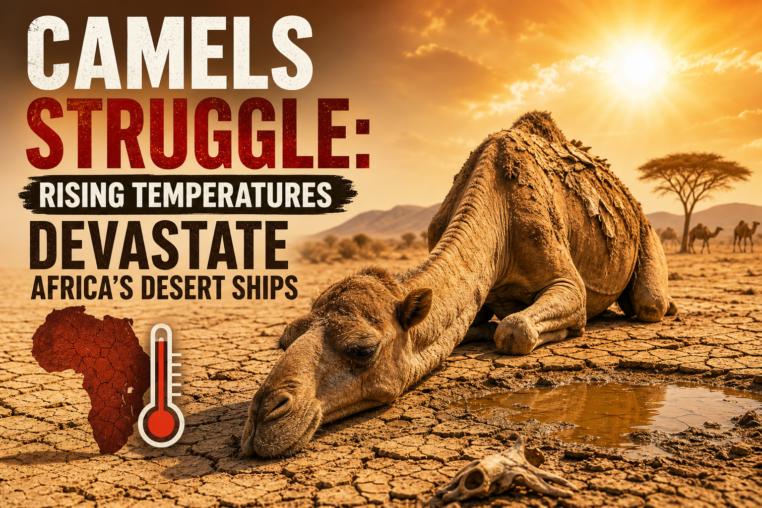
 Camels struggle as rising temperatures devastate Africa’s desert ships, a phrase that once seemed almost mythical now describes a grim reality across the Sahel and Horn of Africa. For centuries, the dromedary camel has been the backbone of pastoralist economies, a resilient beast of burden capable of traversing scorching dunes for days without water. But the accelerating pace of climate change is pushing even these hardy animals to their physiological limits. What was once a symbol of survival in the harshest environments is becoming a casualty of a warming planet, threatening the livelihoods of millions who depend on them.
The camel’s legendary ability to endure heat and dehydration is rooted in remarkable adaptations. They can tolerate body temperature fluctuations of up to six degrees Celsius, reducing the need to sweat and conserve water. Their thick fur reflects sunlight, and their kidneys are extraordinarily efficient at retaining moisture. However, these adaptations evolved for a specific range of conditions. When temperatures consistently exceed 50 degrees Celsius (122°F) for prolonged periods, as is increasingly common in regions like northern Kenya, Somalia, and Chad, the camel’s cooling mechanisms begin to fail. The result is heat stress, which leads to reduced milk production, lower fertility rates, and higher mortality among calves and pregnant females.
One of the most visible signs of this crisis is the dramatic decline in milk yields. For pastoralist communities, camel milk is not just a staple food; it is a primary source of income and nutrition, especially for children. A healthy camel can produce up to 20 liters of milk per day during the wet season. But under extreme heat, production can drop by half or more. This directly undermines food security in regions already plagued by drought and conflict. Women, who are often responsible for milking and selling camel milk, bear the brunt of this loss, seeing their household incomes evaporate as their animals suffer.
Rising temperatures also disrupt the camel’s reproductive cycle. Camels have a long gestation period of about 13 months, and they typically give birth only once every two years. Heat stress can cause early miscarriages, reduce the viability of sperm in males, and delay the onset of puberty in young females. This creates a demographic crisis within herds. With fewer calves being born and higher death rates among the young, the overall population of camels in some regions is stagnating or declining. For pastoralists who measure their wealth in livestock, this is an economic catastrophe that forces families to sell off animals at distress prices or abandon herding altogether.
The impact extends beyond the animals themselves to the entire ecosystem of pastoralism. Camels are not just livestock; they are a form of currency, a means of transport, and a cultural touchstone. When camels struggle, entire social structures begin to fray. Young people, seeing no future in herding, migrate to overcrowded cities. Traditional knowledge about camel husbandry, passed down through generations, is lost. Conflicts over dwindling water sources and grazing land become more frequent and violent. The desert ships, once the solution to arid living, are now a symbol of vulnerability.
Efforts to adapt are underway, but they face enormous challenges. Some researchers are exploring cross-breeding programs to create more heat-tolerant camels, but genetic diversity is limited. Others are experimenting with shade structures and improved watering schedules, but these require resources that many pastoralists lack. Governments and NGOs are promoting early warning systems for heatwaves and drought, but the scale of the crisis often overwhelms local capacity. The most effective long-term solution, of course, is to address the root cause of rising temperatures by reducing greenhouse gas emissions. But for the communities that depend on camels, that is a distant hope.
In the meantime, the plight of the desert ships serves as a stark warning. If temperatures continue to rise, the camel’s struggle will not be an isolated phenomenon. It will be a harbinger of the broader collapse of pastoralist societies across Africa. The resilience that has defined these communities for millennia is being tested as never before. The world must pay attention, not just to the camels, but to the people whose lives are intertwined with theirs. The desert ships are sinking, and if we do not act, they will take an entire way of life down with them.