 Written by
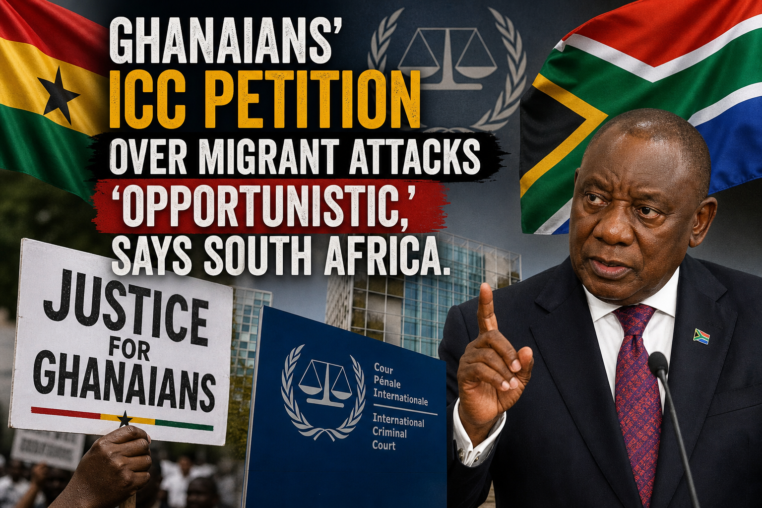
 Ghanaians’ ICC Petition Over Migrant Attacks ‘Opportunistic,’ Says South Africa
The recent petition filed by a group of Ghanaians with the International Criminal Court (ICC) regarding attacks on African migrants in South Africa has been labeled as “opportunistic” by South African government officials. This characterization has sparked a heated debate about the nature of the petition, the underlying issues of xenophobia, and the broader diplomatic relations between the two nations. The petition, which seeks to hold South Africa accountable for alleged failures to protect foreign nationals, has been met with skepticism from Pretoria, which views it as a politically motivated move rather than a genuine attempt to seek justice.
The petition, submitted by a Ghanaian advocacy group, alleges that the South African government has systematically failed to prevent and prosecute attacks on migrants, particularly those from other African countries. The group argues that these attacks constitute crimes against humanity, as they are widespread and targeted against a specific civilian population. The ICC, based in The Hague, is tasked with prosecuting individuals for genocide, war crimes, and crimes against humanity, making it a logical venue for such a complaint. However, South Africa’s response has been swift and dismissive, with officials stating that the petition lacks merit and is an attempt to exploit international legal mechanisms for political gain.
South Africa’s Minister of International Relations and Cooperation, Naledi Pandor, publicly stated that the petition is “opportunistic” and does not reflect the reality of South Africa’s efforts to combat xenophobia. She emphasized that South Africa has a robust legal framework to address violence and discrimination, and that the government has taken concrete steps to protect all residents, regardless of nationality. Pandor also pointed out that the petition ignores the complexities of migration and the socioeconomic challenges that fuel tensions in some communities. By framing the petition as opportunistic, South Africa is signaling that it views the move as a distraction from more pressing issues, such as economic inequality and crime, which affect both citizens and migrants alike.
The timing of the petition is also noteworthy. It comes at a time when South Africa is grappling with high unemployment rates, strained public services, and periodic outbreaks of xenophobic violence. In recent years, there have been several high-profile incidents where foreign-owned businesses were looted and migrants were attacked, particularly in townships and informal settlements. These incidents have often been linked to perceptions that migrants are taking jobs and resources from South Africans. While the government has condemned such violence and deployed police to restore order, critics argue that more needs to be done to address the root causes of xenophobia and ensure that perpetrators are held accountable.
From a legal perspective, the petition faces significant hurdles. The ICC primarily prosecutes individuals, not states, and it only intervenes when national legal systems are unwilling or unable to act. South Africa, as a signatory to the Rome Statute, has a functioning judiciary and has demonstrated a willingness to prosecute hate crimes. For the ICC to take up the case, the petitioners would need to prove that South Africa’s legal system is systematically failing to address attacks on migrants. This is a high bar to meet, especially given that South Africa has a constitutional court that has ruled on issues of discrimination and human rights. Legal experts have noted that the petition is more likely to be a symbolic gesture than a viable legal strategy, aimed at drawing international attention to the plight of migrants in South Africa.
The reaction from the Ghanaian community in South Africa has been mixed. Some support the petition, arguing that it is a necessary step to force the South African government to take action. They point to the trauma and economic losses suffered by migrants during attacks, and they believe that international pressure is the only way to achieve justice. Others, however, are more cautious, fearing that the petition could strain bilateral relations between Ghana and South Africa. Ghana and South Africa have historically enjoyed strong diplomatic ties, with both countries playing leading roles in the African Union and other continental bodies. A public dispute over the petition could undermine cooperation on trade, security, and other issues.
In response to the controversy, the Ghanaian government has distanced itself from the petition, stating that it was filed by a private group and does not represent official policy. This move is likely an attempt to maintain good relations with South Africa while acknowledging the concerns of its citizens. The Ghanaian embassy in Pretoria has also urged its nationals to remain calm and to seek redress through South Africa’s legal channels. This diplomatic balancing act reflects the delicate nature of the issue, as both countries seek to address the grievances of migrants without damaging their bilateral relationship.
Looking ahead, the petition is unlikely to lead to a formal ICC investigation, but it has succeeded in bringing attention to the ongoing problem of xenophobia in South Africa. The debate it has sparked highlights the need for more comprehensive policies to integrate migrants and address the fears of local communities. It also underscores the importance of regional cooperation in managing migration, as no single country can solve the problem alone. For now, the label of “opportunistic” may stick, but the underlying issues raised by the petitioners remain unresolved, and they will continue to demand attention from both South Africa and the international community.