 Written by
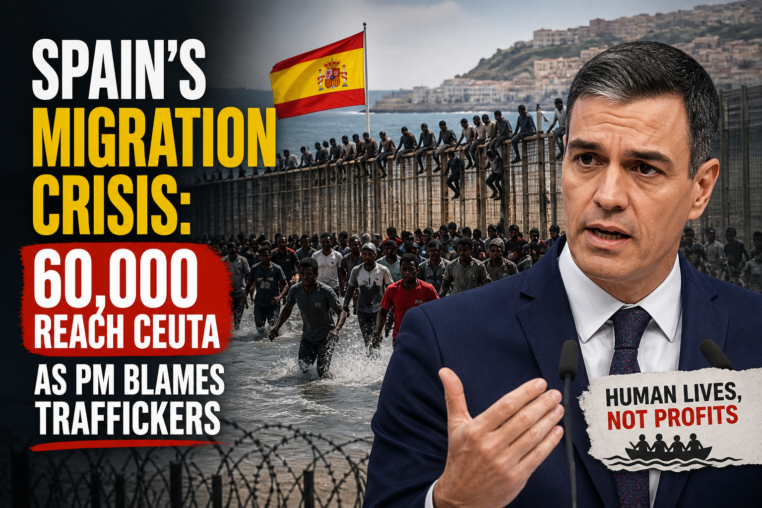
 Spain’s migration crisis has reached a critical inflection point, with over 60,000 individuals arriving in the autonomous city of Ceuta in a single year, a staggering figure that has overwhelmed local infrastructure and ignited a political firestorm. The surge, characterized by perilous sea crossings and land border rushes, has prompted the Spanish Prime Minister to issue a stark condemnation, placing the blame squarely on the shoulders of organized criminal networks. This unprecedented influx is not merely a statistical anomaly; it is a humanitarian emergency that exposes the profound vulnerabilities in European border policy and the desperate realities faced by thousands fleeing economic collapse and instability in North Africa.
The Prime Minister’s Accusation: Targeting Traffickers, Not Migrants
In a nationally televised address, the Spanish Prime Minister did not mince words, directly accusing human trafficking syndicates of orchestrating the mass arrivals. The government’s position is clear: these are not spontaneous movements of people but rather calculated, profit-driven operations that treat human lives as commodities. The Prime Minister emphasized that the primary objective of the state is to dismantle these networks, which he described as “the true enemy of migration,” arguing that they exploit the hopes of vulnerable populations while simultaneously destabilizing Spain’s southern border.
This rhetorical shift is significant. By framing the crisis as a law-enforcement issue against traffickers, the administration is attempting to pivot the narrative away from a purely humanitarian debate toward a security operation. The government has pledged to increase intelligence-sharing with Moroccan authorities and deploy additional maritime patrol assets to intercept the small, overloaded boats that frequently capsize in the Strait of Gibraltar. However, critics argue that this approach, while necessary, does little to address the root causes that make individuals susceptible to traffickers in the first place, such as extreme poverty and political repression in sub-Saharan Africa.
The Humanitarian Toll on Ceuta’s Infrastructure
The sheer volume of arrivals—60,000—represents a number nearly equivalent to the entire population of Ceuta itself. This demographic shock has pushed the city’s reception centers, healthcare facilities, and social services to the breaking point. Local NGOs report that shelters are operating at 300% capacity, forcing many migrants to sleep in public parks, abandoned buildings, and makeshift tent cities along the coastline. The situation has created a public health concern, with sanitation systems struggling to cope with the sudden population surge.
The psychological impact on the migrants is equally severe. Many arrive with hypothermia, dehydration, and injuries sustained during treacherous journeys. Unaccompanied minors constitute a significant portion of the arrivals, presenting a complex legal and ethical challenge for Spanish authorities who are legally obligated to provide them with guardianship and care. The local government has appealed for urgent financial assistance from the central administration in Madrid, warning that without immediate funding, the city faces a complete social collapse. This is not just a border issue; it is a humanitarian crisis unfolding in real-time on Spanish soil.
The Geopolitical Tension with Morocco
The crisis has inevitably strained diplomatic relations between Spain and Morocco. The Prime Minister’s accusations of trafficking have been met with a sharp rebuttal from Rabat, which insists it has been actively preventing departures from its coast. However, analysts suggest that Morocco uses migration as a lever of political pressure, often loosening border controls when it feels slighted by Madrid on issues ranging from fishing rights to the disputed territory of Western Sahara. The recent surge appears to correlate with a diplomatic spat over Spain’s shifting stance on Moroccan sovereignty in the region.
This geopolitical chess game has dire consequences for the migrants caught in the middle. When Morocco tightens its patrols, migrants are forced to take longer, more dangerous routes. When it loosens them, as seen recently, there is a sudden, chaotic rush toward the border fences. The Spanish government is now walking a diplomatic tightrope, attempting to secure Moroccan cooperation to stem the flow without appearing to capitulate to Rabat’s demands. The situation underscores the uncomfortable reality that Spain’s border security is, to a large extent, outsourced to a neighboring state with its own strategic agenda.
Looking Ahead: A Need for a Cohesive European Strategy
As Ceuta struggles to manage the immediate fallout, the broader question remains: what is the long-term solution? The current crisis is a symptom of a fragmented European asylum policy, where frontline states like Spain, Italy, and Greece bear a disproportionate burden. The Prime Minister has called for a “New Pact on Migration” that would enforce mandatory solidarity quotas across EU member states, forcing countries like Germany and France to accept a share of the asylum seekers.
Yet, the political will for such a mechanism remains weak, with several Eastern European nations refusing to accept mandatory quotas. Without a unified European response, Spain will continue to be a pressure valve for the African continent. The focus on traffickers is a necessary immediate step, but it is insufficient. A comprehensive strategy must include massive investment in African economies, legal migration pathways, and a robust, humane asylum process. Until then, the 60,000 arrivals in Ceuta will likely be just the beginning of a recurring seasonal tragedy, a stark reminder that geography has made Spain the gateway to Europe, and with that gateway comes an immense, shared responsibility that cannot be managed by a single nation alone.